You can spend an afternoon arguing about whether a service should be a class, a module, a hook, an actor, or a handful of functions. The argument feels important because the code is in front of you. It has names, shapes, dependencies, and a style that can be judged immediately.
The customer does not see any of that.
The customer sees whether an invoice is correct, whether a payment is safe, whether a report arrives before the meeting, whether an account can be recovered, and whether the next change makes those things more reliable or less. The implementation is the machinery. The business outcome is the thing being built.
That does not make implementation details irrelevant. They still determine cost, security, operability, accessibility, and the range of changes a system can survive. They are choices made in service of behavior that can be observed, tested, reviewed, and changed.
Three generations, one engineering system
The important shift happened in three generations. First came automated proof. Then came continuous delivery. Now AI can multiply the amount of implementation a team can produce. Each generation is useful on its own. Together, they change what software work is for.
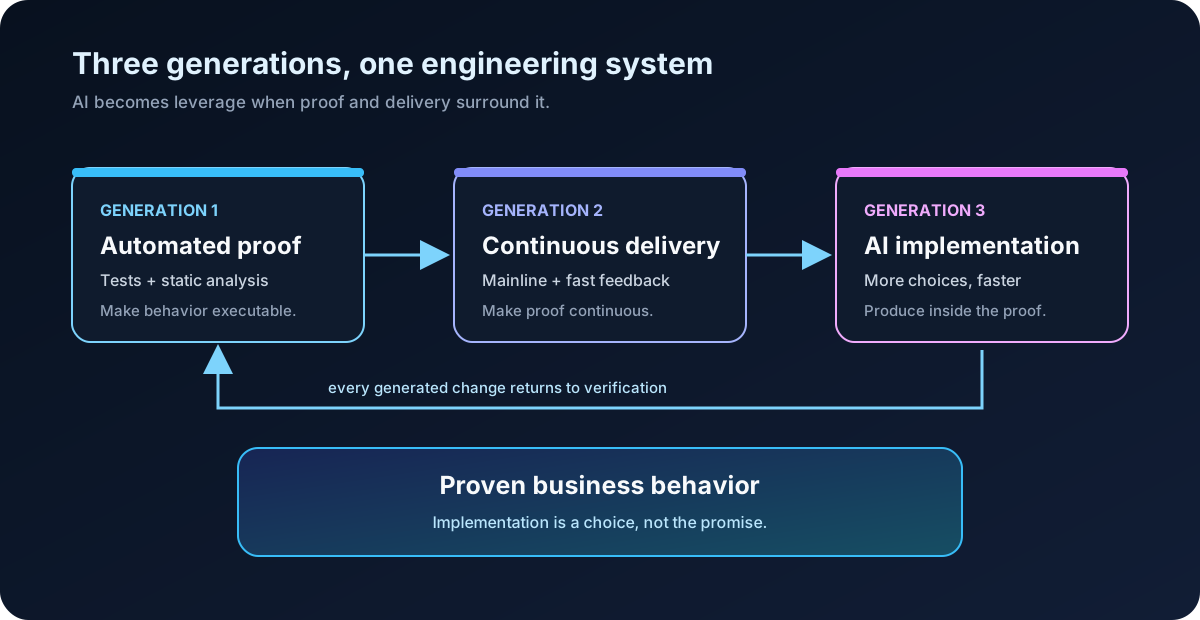
First generation: prove the behavior
The old version of programming expertise was partly a reading performance. A developer could take pride in understanding a difficult tangle of control flow. The tangle became evidence of difficulty, and the ability to hold it in the head became evidence of ability.
Automated testing changed the standard. The question became less “Can another engineer eventually understand this?” and more “Can the system demonstrate that it satisfies the rule?”
A requirement is a claim about behavior:
- When a customer pays twice, the account is charged once.
- When an authorization expires, access is denied.
- When a shipment is delayed, the customer is told before the support team has to discover it.
- When a record is missing, the system returns the defined failure rather than inventing a success.
A test turns one of those claims into an executable witness. It does not prove the entire system correct. No finite suite can do that. It gives the team a repeatable way to preserve known behavior while the system changes.
Static analysis adds a second kind of proof. A test asks what happens for selected inputs at runtime. An analyzer examines source code for classes of weakness, inconsistency, or suspicious structure before every path has been exercised. NIST describes source-code security analysis as examining source files to detect and report weaknesses that could lead to vulnerabilities. NIST also makes the boundary clear: a tool cannot identify every weakness, and people still have to evaluate findings and decide what risk to accept.
That boundary creates a useful division of labor. The machine watches the rules that can be stated precisely and checked repeatedly. The team spends its attention on the missing state, the conflicting requirement, and the user who was not represented in the original model.
Tests and analysis also make implementation less precious. If two designs satisfy the same observable requirements, pass the same safety checks, and remain operable at an acceptable cost, the choice between them becomes a trade-off. The internal shape can change without taking the business promise with it.
Second generation: make proof continuous
Proof becomes more valuable when it arrives while a change is still small.
Martin Fowler’s account of continuous integration centers on a simple discipline: everyone integrates with the mainline frequently, and every integration is checked by an automated build. The benefit is the shrinking interval between a change and the moment the team learns whether that change conflicts with the rest of the system.
A conflict found after ten minutes is a local repair. The same conflict found after three weeks is archaeology.
This is why long-lived feature branches are more than a version-control preference. They defer integration. Fowler notes that feature branches can prevent early detection of problems and discourage refactoring, especially when work remains isolated for weeks or months. The branch protects the code from the team, then presents the accumulated risk as a merge event.
Continuous delivery changes the cost of that delay. DORA defines continuous delivery as the ability to release changes of all kinds on demand, quickly, safely, and sustainably. It does not require every commit to reach production immediately. It requires the organization to make a release without a ritual of fear.
The mechanism is a feedback loop:
requirement → test → AI-assisted implementation → static analysis → review → release → production evidence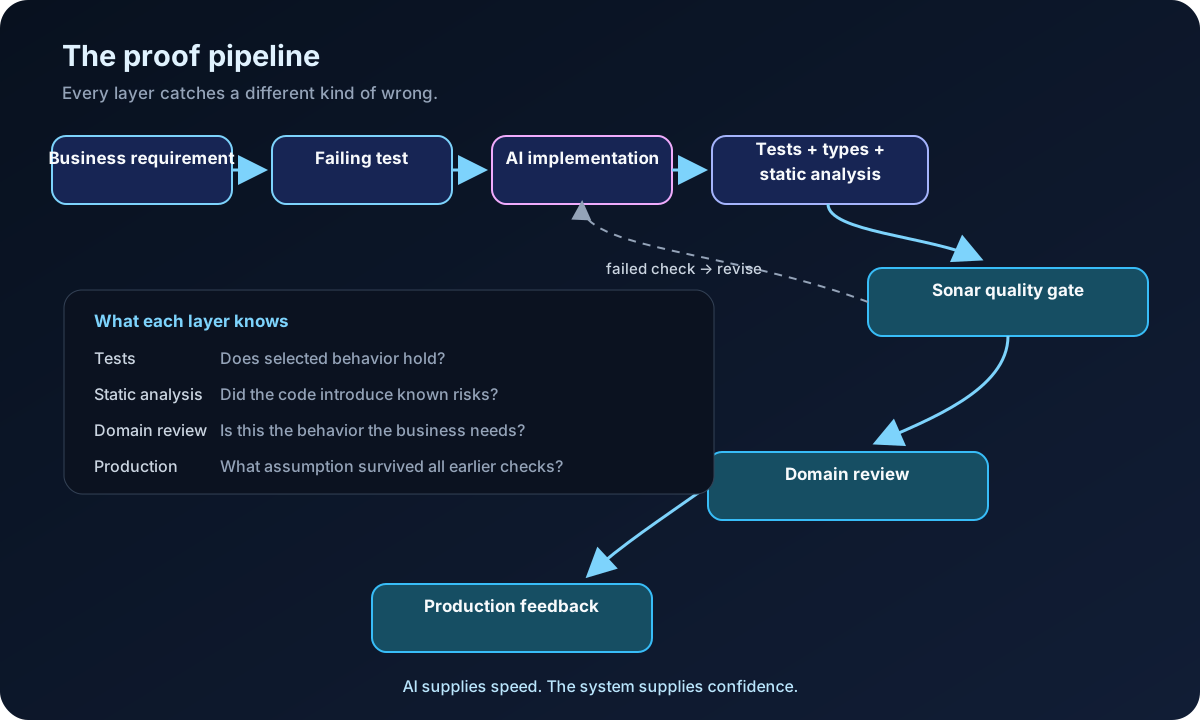
The arrow from implementation to static analysis is where the second generation turns the first into a daily practice. Tests run on every change. Type checks and analyzers run beside them. A quality gate evaluates the new code against rules the team has chosen. Continuous integration reports the result while the change is still in the developer’s working memory. Continuous delivery keeps the distance from a green build to a real release short enough for product and operations to respond.
A quality gate is not a magic wall. Sonar documents gates as conditions applied to analyzed metrics, including new issues, test coverage, duplication, security, reliability, maintainability, and code complexity. A team can configure the gate to reject new maintainability problems or complexity-related findings. If the CI provider requires that gate to pass before merging, the change stops before it reaches the shared branch. The exact threshold is a policy decision. The important decision is making the policy executable.
The result is not speed for its own sake. A small change reaches a real environment. A product owner sees whether the behavior answers the requirement. An operator sees whether the system remains healthy. A customer reveals an assumption that no test contained.
Feature branches can still be useful. A short-lived branch for review or an experiment hidden behind a feature flag is different from a month-long alternate reality. The question is whether the branch delays learning.
Third generation: let AI produce inside the proof system
AI makes the argument impossible to ignore because it can produce implementation details faster than a team can review them by aesthetic inspection.
A coding model can generate a route, refactor a module, write a migration, explain an unfamiliar package, or propose tests before the coffee cools. That is useful. It becomes dangerous when output volume is mistaken for verified progress.
Without automated proof, AI reduces the cost of producing uncertainty. A missing edge case becomes a polished function. An incorrect assumption becomes a helpful abstraction. A dependency choice becomes permanent because undoing it costs more than accepting it. Calling this AI technical debt gives the tool too much credit. The debt was already possible. AI increases the rate at which it can arrive.
The 2026 evidence shows why the surrounding system matters. A 2026 meta-analysis of 23 studies and 27 effect sizes found a moderate positive productivity effect for generative-AI coding assistants. The separate three-company field experiments summarized in that research report an estimated 26.08% increase in completed tasks, though the individual experiments were noisy. The meta-analysis also found substantial variation: gains were larger in controlled experiments and smaller in open-source and enterprise work.
A longitudinal 2026 study of autonomous coding agents found a sharper trade-off. Agent adoption produced substantial initial velocity gains when a repository had not previously used an AI tool, but little or short-lived benefit when an AI IDE was already in place. Across both groups, static-analysis warnings and cognitive complexity increased, by roughly 18% and 35% in the study’s estimates. More code moved. The maintainability bill moved with it.
That is a bad practice before it is an AI problem: optimizing for output while leaving complexity, review cost, and future change outside the acceptance criteria. The agent does not invent that incentive. It exposes and accelerates it.
A quality gate gives the team a way to push back. If an agent adds a method whose cognitive complexity crosses the configured threshold, introduces a new maintainability issue, reduces coverage on new code, or adds duplication, the analysis can report it. CI can require the gate before merge. The agent can then simplify the implementation, add the missing test, or explain why a narrowly accepted exception is necessary.
Static analysis cannot prove that the requirement is correct. It can tell you that the code is difficult to maintain. Tests can tell you that selected behavior holds. Domain review can tell you whether the selected behavior is what the business actually needs. Production feedback can reveal the assumption that all three missed.
That is the combined system:
business requirement
  → failing test
  → AI-assisted implementation
  → tests and type checks
  → static analysis and quality gate
  → domain review
  → continuous delivery
  → production feedback
AI is powerful inside this sequence because it is no longer being asked to guess the definition of done. The requirement supplies the target. The tests make part of the target executable. Static analysis constrains the shape of the result. Review supplies judgment. Delivery and production supply evidence from outside the development environment.
The studies point to the same lesson
The newer evidence is not a simple argument between “AI makes developers faster” and “AI makes developers slower.” It is a map of conditions.
The Microsoft study of Claude Code and GitHub Copilot CLI reported that adopting engineers merged roughly 24% more pull requests during its four-month observation window. The authors are careful about what that number means: a merged pull request is a throughput measure, not a measure of business value or software quality. Throughput is an instrument reading. It is not the destination.
The autonomous-agent study found that increased throughput can arrive with increased cognitive complexity and static-analysis warnings. Those are precisely the kinds of signals a configured analysis pipeline can surface before they spread through the codebase. The meta-analysis found that results vary by context, which is another reason to measure the workflow around the tool rather than repeat a productivity percentage as if it were a law of nature.
The older evidence belongs in the picture too. METR’s randomized 2025 study found that experienced open-source developers using early-2025 AI tools took 19% longer on measured tasks, despite expecting a speedup. That result does not cancel the studies showing gains. It shows why the task, repository, developer, tool, and review standard matter.
The practical response is not to choose the study that confirms a preference. It is to define productivity in terms the business can defend. A useful measure might include delivery time, escaped defects, change-failure rate, time to restore service, review effort, maintainability, and whether the released behavior solved the intended problem. Pull requests and lines of code can remain useful operational signals. They cannot carry the whole meaning of productivity.
What implementation details are for
Saying that implementation details are a choice does not mean all choices are equal or that craftsmanship is obsolete.
A slow query can make a correct feature unusable. A poor authorization boundary can turn a passing test into a breach. A framework upgrade can create years of maintenance work. A leaky abstraction can make every future requirement expensive. These are business consequences, even when they first appear as technical details.
The distinction is between implementation as a destination and implementation as a means.
When implementation becomes the destination, teams optimize for preferred languages, framework loyalty, clever abstractions, or the satisfaction of making complexity legible. When implementation remains a means, those concerns are judged by their consequences. Does this lower operational risk? Does it make the rule easier to verify? Does it keep the next requirement affordable? Does it give the team a safer way to change direction?
Testing, static analysis, domain review, and production observation make those questions answerable. Continuous delivery keeps the answers current. AI expands the number of implementation choices the team can explore, but the proof system decides which choices are safe enough to keep.
Start with the missing proof
If your team is choosing a framework before it can explain how a requirement will be verified, the order is backwards.
Start with a rule that matters. Write down the behavior. Test the normal case, the boundary, the failure, and the recovery. Add static analysis for the mistakes the system is likely to make, including complexity and maintainability problems. Put the checks on every change. Require the quality gate before merge. Ask someone who understands the domain to review the interpretation. Then shorten the distance between a green build and a real release.
Do not begin by demanding hundreds of deployments a day. Make the next deployment boring. Do not ask an AI tool to build an entire feature from a vague sentence. Give it a requirement, a failing test, a bounded context, and a way to prove its work.
The language and framework will still matter. They will matter as tools chosen under constraints, not as substitutes for knowing what the system must do.
Once the behavior is proven, AI can change the implementation without changing the promise.
Sources
- Manifesto for Agile Software Development, especially its emphasis on working software, customer collaboration, and responding to change.
- Continuous Integration, Martin Fowler, on frequent integration, self-testing builds, and mainline development.
- Feature Branch, Martin Fowler, on the costs of deferred integration.
- Capabilities: Continuous delivery, DORA, on releasing safely and sustainably on demand.
- Source Code Security Analysis, NIST, on what static source analysis can and cannot establish.
- Understanding quality gates, Sonar, on conditions, new-code quality, test coverage, and merge decisions.
- A Meta-analysis of the Effect of Generative AI on Productivity and Learning in Programming, synthesizing 23 studies and 27 effect sizes across programming productivity and learning.
- AI IDEs or Autonomous Agents? Measuring the Impact of Coding Agents on Software Development, a longitudinal study of agent adoption, throughput, static-analysis warnings, and cognitive complexity.
- Adoption and Impact of Command-Line AI Coding Agents, a study of Microsoft’s early-2026 rollout of Claude Code and GitHub Copilot CLI.
- The Productivity Effects of Generative AI, a field experiment on GitHub Copilot across software developers at Microsoft and Accenture.
- Measuring the Impact of Early-2025 AI on Experienced Open-Source Developer Productivity, METR, on a randomized study of AI-assisted development in mature open-source repositories.